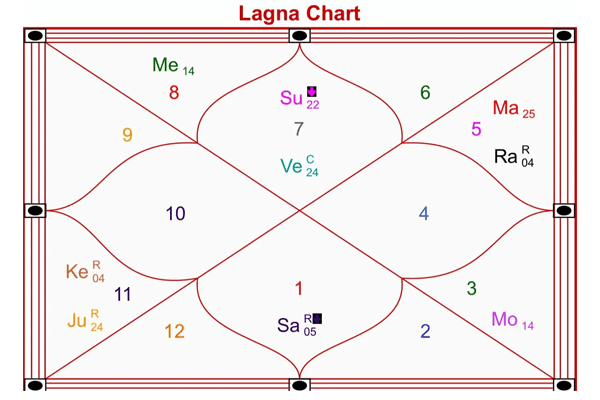
Ascendant

The method of finding the Lagna

The method of finding the Lagna (Ascendant). The method of finding the Lagna (Ascendant) for the birth time. The sign of the Zodiac rising in the eastern horizon at the time of birth is the Ascendant or lagna, that is to say, the rising Sign at birth is the ascendant. At sunrise on each day, that sign named after the Hindu solar month (in which the day falls) will be rising in the eastern horizon. This is because during each month the Sun would be in the corresponding sign of the Zodiac. For example, during the solar month Maesha, the Sun occupies, (it apparently moves through) the sign Maesha (Aries). Thus, on the first day of Maesha, the Sun and the sign Maesha would rise together and the sign Moesha would be at the eastern horizon for about 1/12 of a day (2 hours) from Sunrise. On the second day of the Maesha month, Sun apparently would have moved I degree in the sign Maesha, so that the sign Maesha would be I degree up in the eastern horizon at Sunrise. Thus, the sign Maesha would be 4 minutes earlier than the Sun (since I degree corresponds to 4 minutes). Hence Maesha sign would be in the eastern horizon from 4 minutes before sunrise till 1 hr. 56 min. after sunrise. Hence on the second day the rising time for Maesha is Ihr. 56 min. after sunrise. Similarly on the 16th of Maesha, the Maesha Sign would be in the eastern horizon only. 4 min multiplied by 15 = 1 hr after Sunrise. Thus, the rising period or the rising of a month would gradually fall at the rate or 4 minutes per day and will reduce to zero after the 30th day that month. 30 x 4 min. = 2 hrs. This means that the Sun has crossed over to the next sign and the month also would have changed. The rising period on each day of the rising sign can thus be calculated, and it is called the udayaathpara, meaning balance of the sign after sunrise, rising period of that sign in that date. After fixing the time of rising of the rising sign, the next 2 hrs. will be the rising period of the next sign and so on, till the next sunrise. This is only an approximate method of calculation, because, due to the shape of the orbit and the difference between the latitudes of each place on the to place, depending on the latitude. The riing period of each sign, called raasimaana has to be for each place and these data are usually available in the conventional almanacs. These a usually in Ghatis and Vighatis, which can converted into hour-minute (1 Ghati=24 mins,  1 Vighati = 24 Seconds). Further the sunrise for each day also varies from place to place and from day to day. The time of sunrise for each day is given in almanacs.

The method of finding the Lagna Read More »

Uncategorized, , , , ,

lagna

lagna Ascendant, or Lagna (ल), holds a position of utmost significance in the realm of astrology, symbolizing the intersection of cosmic forces with individual destinies. Its determination marks the emergence of a specific zodiac sign on the eastern horizon at the precise moment of an event, such as the birth of a child. The ascendant’s calculation involves various methodologies, each offering distinct insights into its interpretation: The cyclical movement of the Earth around its axis and the apparent motion of the Sun through the zodiac signs form the basis for understanding the ascendant’s significance. Each moment witnesses a unique zodiac sign ascending on the eastern horizon, aligning with the Sun’s position and marking the beginning of a new cycle. Just like the year, the time taken by the earth to revolve around the Sun, which is about 365 days, is divided into 12 parts and each part is denoted by its specific name (Maesha, Vrishabha, etc). The time between a sunrise to next sunrise (about 24 hours) is also divided into 12 parts of about 2-hour duration and each part is given the name of the 12 signs. Thus, if the sunrise on the first of a month (Hindu month) is at 6.30 A.M., about two hours from that time is the first Sign (this means that this Sign of the Zodiac will be on the eastern horizon, rising with the Sun). The next two hours, the second sign and so on. It is evident that the two hours before the next sunrise will be the 12th Sign. In other words, the Zodiac is divided into 12 Signs-Marsha, Vrishabha, ……. Meena, etc. The sign (Rasi) which is found in the eastern horizon at any specified time is called the Ascendant or Lagna (Udayalagna/rising sign). Thus, if a child is born at 11 A.M. on the first day of the month Vrischika, Lagna or ascendant is calculated as follows. 6.30 AM. The rising sign on that day is Scorpio (Vrischika) Therefore 6 30 to 8.30 AM, is the time roughly when the Sign Scorpio (Vrischika) would be on the eastern horizon. The next Sign Sagittarius (Dhanus) will be on the eastern horizon during the next 2 hours roughly (8.30 to 10.30 A.M.). From 10.30 A.M. the Sign Capricorn (Makara) would rise and continue to be on the eastern horizon till 12.30 noon. Therefore, the ascendant of the child born at 11 A.M. in the month of Scorpio (Vrischika) will be in the sign Capricorn (Makara). Therefore, the ascendant of the child born at 11 A.M. in the month of Scorpio (Vrischika) will be in the sign Capricorn (Makara). This information itself, namely that the child is born in the Capricorn ascendant (Makara Lagna), would indicate, quite a lot about the behaviour and general features of that child. The experiences (good as well as bad) in the life of a person, as also all the relations between persons and different aspects of the universe, have been classified into 12 parts in astrology, similar to the division of space and time into 12 parts. Human experiences (including the previous births of the soul) and human relations have also been divided into 12 distinct sets. These sets are called the 12 houses or sectors or Bhaava. The sign at a birthtime is the Janmalagna (ascendant) of the person. In the birth chart, the Lagna will be indicated in that sign which rises in the east. The ascendant is marked as the first Bhaava (First house) for the person. Thus, having fixed the first house, the second, third, etc. are marked in subsequent signs starting from the first house, in the clockwise order. For example, for a person whose Lagna (ascendant) is in the Sign Cancer (Kataka), his second house is Leo (Simha), third house is Virgo (Kanya), eleventh house is Taurus (Vrishabha) and twelfth house is Gemini (Mithuna), If in a horoscope, the ascendant is in the sign Sagittarius (Dhanus), then the native has his first house or Lagna Bhaava in Sagittarius (Dhanus), the second house in Capricorn (Makara), third house in Aquarius (Kumbha.). eleventh house in Libra (Thulaa) and twelfth in Scorpio (Vrischika), etc. It is evident from the above two examples that each house from the first to the twelfth may fall in any sign, depending upon (Lagna) which is decided by the birth-time. If in the first example, the VII house is Capricorn (Makara), in the second example the VII house is Gemini (Mithuna). This is because of the difference in lagna in the two cases. Sign and house do not have the same meaning. The division of Zodiac into signs is based on the motion of the Sun while division of the Zodiac into houses is based on the birth-time (Lagna) and rotation of earth on its axis. The identification of the 12 houses in a birth-chart is absolutely important. Therefore, in order to identify the houses, one should be able to the Lagna in each birth chart. In practical terms, the ascendant at birth, known as the Janmalagna, shapes an individual’s characteristics and life experiences. It serves as the cornerstone of the birth chart, with subsequent houses delineated clockwise from the ascendant, each representing distinct aspects of human existence and relationships. More about method of finding Lagna later….

lagna Read More »

Uncategorized, , , , , , , , , ,